Saturday, April 11, 2009

Friday, April 10, 2009

My LPs will be converts to Mp3 ???


Edmundo Floss, author of this blog, hear their LPs on one of your appliances. Note that the appliances are old fashioned way. Floss not have ring-disks and any other device to convert your LPs into MP3.

Wednesday, April 8, 2009

Help me !

I have these LPs. But as I not have how change them in MP3. What do I do? I open an account on paypal and the readers of the blog help me to buy the necessary equipment for this?


Saturday, April 4, 2009

Hollywood's top music composer Maurice Jarre dies


Tributes poured in on Monday for Maurice Jarre, the Oscar-winning French composer of music scores for such timeless films as "Doctor Zhivago" and "Lawrence of Arabia", who died at age 84, in 29 of march (2009).
Jarre died in Los Angeles in the early hours on Sunday after suffering from cancer, a spokesman for his son Jean-Michel Jarre told AFP.
Hollywood's most decorated composer, Jarre had written more than 150 scores for a range of films from thrillers to love stories, working with star directors like John Huston, Alfred Hitchcock and Franco Zeffirelli.

He won his first Oscar for "Lawrence of Arabia" in 1962 and three years later was awarded a second statuette for "Doctor Zhivago", famous for the tearful balalaika of "Lara's Theme." Both films were directed by David Lean.
A third Oscar came in 1984 for best original music score for "A Passage to India", which he wrote for a full symphonic orchestra and marked yet another collaboration with Lean.

President Nicolas Sarkozy described Jarre as a "great composer" and praised his "majestic and full-bodied works, popular and classical music."
"By working with some of the greatest filmmakers in the world, he showed that music can be just as important as pictures to make a beautiful and successful film," said Sarkozy.
Jarre had also written the score for "Witness" from director Peter Weir in 1985 and joined him again in 1989 to compose the music to "Dead Poets Society".
Other music scores include "Ghost" in 1990 and "I Dreamed of Africa" in 2000.
Other than the three Oscars, Jarre won countless accolades for his scores including Golden Globes and BAFTA British film awards. He also wrote music for theatre and ballet.

"He was a creative, modern musician who showed a perfect mastery of sound. His music provided a counterpoint to the pictures and formed one with the film," said French Culture Minister Christine Albanel.
"He was Hollywood's greatest musician," said French singer Mireille Mathieu.
"His fantastic and timeless scores are in perfect osmosis with the films."
"He was a great man of music and film, but also a great ambassador for France," said Mathieu who singled out for praise the score to the 1966 film "Is Paris Burning?" about the French Resistance.

Born in the central city of Lyon, Jarre was studying engineering when he switched to music. He recounted being inspired by the works of conductor Leopold Stokowski.
He studied percussion and joined French composer Pierre Boulez who wrote for a Paris theatre.
In 1952 Jarre wrote his first score for the short film "Hotel des Invalides," at the request of director Georges Franju.
"In filmmaking, the composer is always the last link," Jarre told Le Journal du Dimanche daily a few years ago.

"Often you find yourself working with a producer who can't wait to release his film. So you have to work quickly. For Lawrence of Arabia, I was given six weeks to write two hours of music."
Jarre moved to the United States in the mid-1960s and briefly settled in Switzerland before returning to Los Angeles.
During his last public appearance in Europe, he was awarded a Golden Bear at the Berlin film festival in recognition of his life's work.
His son Jean-Michel Jarre rose to prominence as a composer in his own right with the worldwide electronic music sensation "Oxygene" in 1976. He also has a daughter Stephanie and second son Kevin.

© 2009 AFP

Thursday, April 2, 2009

Tony Hatch - The GREAT !


Tony Hatch (born Anthony Peter Hatch, 30 June 1939, Pinner, Middlesex, England) is an English composer, songwriter, pianist, music arranger, and producer. Allmusic journalist, Richie Unterberger, states "Hatch had success in various segments of the entertainment industry from the 1960s onwards, but he will be best remembered for his work as a producer and songwriter for several British pop and rock stars in the 1960s. As a staff producer at Pye Records, Hatch worked with The Searchers, Petula Clark, his wife Jackie Trent and on several mid 1960s singles by David Bowie, long before that singer had become famous. Hatch's productions boasted a clean and well-arranged sound that, particularly on his collaborations with Petula Clark, displayed some traces of mainstream pop and Broadway.


Encouraged by his musical abilities, his mother — also a pianist — enrolled him in the London Choir School in Bexley, Kent when he was ten. Instead of continuing at the Royal Academy of Music, he left school in 1955 and found a job with Robert Mellin Music in London's Tin Pan Alley.

Before long, he was writing songs and making a name for himself within the music industry, joining the Rank Organisation's new diskery, Top Rank Records; there he worked for the once and future Decca Records A&R man Dick Rowe. When National Service called him away from his chosen profession, he managed to become involved with the band of the Coldstream Guards. On his return in 1959, Hatch began his own recording career with a cover version of Russ Conway's piano instrumental, "Side Saddle". In 1960, Garry Mills' recording of Hatch's composition "Look For A Star", appeared in the soundtrack to the horror film, Circus of Horrors,[3] and became a Top 10 hit in the UK for Top Rank. Four versions of the song charted simultaneously in the United States, including Mills' original and a version by 'Gary Miles' (a recording pseudonym of a future member of The Crickets, Buzz Cason). Top Rank, despite some worldwide success with artists such as Jack Scott and The Fireballs, ultimately was done in by a quirky distribution arrangement with EMI. A swift succession of events ensued through 1961. Top Rank was sold to EMI, briefly operated as a subsidiary, with hits by John Leyton, and shuttered, with its artist roster transferred to other EMI labels. Hatch moved on to a part-time job with Pye Records, where he assisted his new mentor, Alan A. Freeman, with the recording of "Sailor", a #1 hit for Petula Clark. In October 1962, Hatch made his own foray in the UK Singles Chart with "Out Of This World".

Hatch continued to write songs for Pye artists, sometimes under the pseudonym 'Mark Anthony'. In 1963, Philadelphia teen idol Bobby Rydell hit the charts with "Forget Him", written and produced by Hatch, who went on to produce, arrange and write for other American stars such as Keely Smith, Connie Francis and Pat Boone. In 1964 he wrote (under the pseudonym of 'Fred Nightingale') The Searchers' hit "Sugar and Spice". His most significant role in 1960s British rock music was as producer during the Searchers' 1963-66 commercial prime, a span which saw them have their biggest hits. The Searchers' records boasted well-balanced vocal harmonies and melodic guitars, sometimes played on 12-string models, that at their most progressive anticipated the jangle that would become a prime feature of folk rock.

Wednesday, April 1, 2009

Ladies and Gentlemen : BOBBY VINTON !!!

Bobby Vinton (born Stanley Robert Vintula, Jr., April 16, 1935, Canonsburg, Pennsylvania (near Pittsburgh) is an American pop music singer.


After a brief spell in the U.S. Army, Vinton was signed to Epic Records in 1960 as a bandleader: "A Young Man With a Big Band." Two albums and several singles were not successful however, and with Epic ready to pull the plug, Vinton found his first hit single literally sitting in a reject pile. The song was titled "Roses Are Red (My Love)." It spent four weeks at No.1 on the Billboard Hot 100. Arguably, his most famous song is 1963's "Blue Velvet", originally a minor hit for Tony Bennett in 1951, that also went to No.1. Twenty-three years later, David Lynch named his movie Blue Velvet after the song. In 1990, "Blue Velvet" climbed to the top of the music charts in Great Britain, after being featured in a Nivea Skin Cream commercial. In 1964, Vinton had two #1 hits, "There! I've Said It Again" (a #1 hit in 1945 for Vaughn Monroe) and "Mr. Lonely". Harmony Korine named his 2007 film Mister Lonely after the latter, and it is now also the basis for Akon's hit "Lonely."

Vinton's version of "There! I've Said It Again" is noteworthy for being the final U.S. Billboard number one single of the pre-Beatles era; it was deposed from the top of the Hot 100 by "I Want to Hold Your Hand." Also noteworthy is the fact that Vinton continued to have big hit records during the British Invasion, while Connie Francis, Ricky Nelson, the Shirelles and other major artists of the early 1960s struggled to reach even the Top 30.

Vinton's 1967 hit "Coming Home Soldier" was a favorite on request shows on the American Forces Network during the Cold War and Vietnam Era, often called in by soldiers about to board the Freedom Bird that would take them back to the "Land of the Round Doorknobs." His 1968 hit "I Love How You Love Me" sold over one million copies and was awarded a gold record by the R.I.A.A.

In the 1970s, the "Polish Prince" continued to hit the Top 40, notably with "Ev'ry Day of My Life" and "Sealed With a Kiss" in 1972. That same year, Epic Records decided to drop Vinton from his contract (despite the moderate success of these two hits), claiming that his days of selling records were over. Undeterred, Vinton spent $50,000 of his own money on a self-written song sung partially in Polish: "My Melody of Love". After Vinton was turned down by seven major labels, ABC Records bought Vinton's idea, and the result was a multi-million selling single that hit #3 on the Billboard Hot 100 chart and #1 on the AC charts in 1974.[2] A gold album, Melodies of Love, followed as well as one more Top 40 pop hit ("Beer Barrel Polka" in 1975), a successful half-hour variety show The Bobby Vinton Show (which aired from 1975 to 1978), which used "My Melody of Love" as its theme song; ABC Records subsequently released an album of songs performed on the show. He also starred in two John Wayne movies: Big Jake and The Train Robbers.

Billboard Magazine called Bobby Vinton "the all-time most successful love singer of the 'Rock-Era'". From 1962 through 1972, Vinton had more Billboard #1 hits than any other male vocalist, including Elvis Presley and Frank Sinatra. In recognition of his recording career, Bobby Vinton has a star on the Hollywood Walk of Fame at 6916 Hollywood Blvd.

Poor old JOHNNIE RAY !!!


Poor old Johnnie Ray. I don't know of many performers who were so huge in their heyday and so forgotten today. America's first bisexual superstar, some consider johnnie rayhim jonny rayto be the missing link between Sinatra and Elvis. He even broke Martin and Lewis's attendance record at the Copacabana. A friend and proponent of, and early acknowledged influence on Elvis Presley, Johnnie is virtually ignored by the nostalgic radio staions of today.

Historians often refer to Buddy Holly and Elvis as being the guys who broke the colour barrier by sounding black but Johnnie Ray was the first prominent artist to enter the charts under that guise. His historic arrests for solicitation at a time when it made front page news make him arguably the most notorious of all R&B performers. He claimed that Frank Sinatra helped orchestrate his capture, in some of the instances of his arrests, because of his romantic affiliation with Sinatra nemesis Dorothy Kilgallen, a powerful New York columnist.

Johnnie died quietly and with no fanfare, in a hospital room in 1990 of complications of liver disease. Tips on Tables - Robert W. Dana - February 23, 1953

Ray's Audience Swells Flood Of His Tears

It may be difficult to imagine a revival meeting taking place at Jules Podell's Copacabana, but, that's exactly what's going on there, these nights with Johnnie (Mr. Weeper) Ray as star of the show. While cry boy delivers his lachrymose songs, the on-lookers stamp and clap, weep and groan,, and by the time Mr. Ray completes his whining, stammering performance and indescribable hypnotic spell seems to have been cast over the johnny rayentire audience. Mr. Ray's opening number a peppy tune called "You Go Your Way, I Gotta Go Mine" offered little, Indication of what was to come. Gradually he became sadder and sadder with renditions of "The Touch of God's Hand" and "The Little White Cloud."

Wasted Handkerchief No sooner did he sing the opening notes of "Cry" than a girl sitting at the ringside burst. into tears. The gallant Mr. Ray handed her his handkerchief, but that only made the girl weep harder out of sheer joy, no doubt. His interpretation of "Walk and Talk With The Lord" was accompanied by vigorous clapping from the audience , and then, Mr. Ray, his face wet with perspiration, panting from exhaustion, walked off amid a thunderous ovation. A nice. contrast, to Mr. Ray's frenetic shenanigans Is the likable, vivacious comedy team of Betty and Jane Kean.

The sisters have been held over from the last show and they have retained jonnie raysome of the material from their previous engagement. But that should deter no one from seeing them again. For the Keans offer a delightful, boisterous act that includes dancing, singing, and hilarious caricatures of Marilyn Monroe, Frankie Laine, Bette, Davis, Christine Jorgensen and among other, The Gabor Sisters.Others on Bill

Rounding out the bill are The Nicholas Brothers, who give forth with some breathtaking dance steps; Helene Dimone, a singer who bears remarkable resemblance to Margaret Phelan: Romona Lang and Jack Purcell, who contributed to the dancing portion of the how, and Ted Martin, curly haired singer with a pleasant song delivery. Michael Durso's Orchestra provided music, good musical accompaniment for the show.

Monday, March 30, 2009

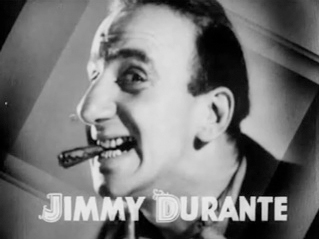
Jimmy Durante


Before Jimmy Durante became one of the most famous and lovable entertainers of the Twentieth Century, he was a hot piano player and bandleader. Durante was greatly influenced by Scott Joplin and had his first success in show business as a Ragtime piano player starting around 1911.
He was billed as "Ragtime Jimmy" and played in New York City and Coney Island. Durante was part of the same wild crowd of early White jazz musicians as the Original Dixieland Jazz Band and Johnny Stein. When the New Orleans Jazz style swept New York by storm in 1917 with the arrival of the Original Dixieland Jazz Band Durante was part of the audience at Reisenweber's on Columbus Circle.
Durante was very impressed with the band and invited them to play at a club called the Alamo in Harlem where Jimmy played piano. The band was soon the hottest thing in show business and Durante had his friend Johnny Stein assemble a group of like-minded New Orleans musicians to accompany his act at the Alamo.
They billed themselves as "Durante's Jazz and Novelty Band". In late 1918 they recorded two sides for Okeh under the name of the New Orleans Jazz Band, they re-did the same two numbers a couple of months later for Gennett under the name of Original New Orleans Jazz Band, and in 1920 the same group recorded again for Gennett as Jimmy Durante's Jazz Band.
In 1921, Durante collaborated with an African-American songwriter by the name of Chris Smith on the songs "Let's Agree To Disagree" and "Daddy, Your Mama Is Lonesome For You" which were recorded by Mamie Smith. Durante went on to record with several White Jazz bands in the early 1920s including The Original Memphis Five, Ladd's Black Aces, Bailey's Lucky Seven and Lanin's Southern Serenaders. Jimmy was a solid Ragtime and Jazz piano player, but soon gravitated towards vaudeville as the 1920s wore on. He became part of a comedy music team called "Clayton, Jackson and Durante".
By the end of the decade the team was very popular on Broadway and Durante got a role in a play called "Jumbo" which made him a star. In the early 1930s he started to get roles in movies, and became popular on radio and eventually became one of the most popular entertainers in America. On his radio show he joked that he was working on a symphony, but he wouldn't call it "Rhapsody In Blue" or anything like that. He would call it "Inka Dinka Do".
In 1934 he recorded a novelty song with this title and it became his signature tune. Jimmy's popularity never really faded and he became one of the first stars of television. In his later years he was often cast as a lovable relic of the Roaring 20s, but few remembered him as one of the first Jazz recording artists.

Thursday, March 26, 2009

Crisis time !!!


In brazilian tupi-guarani

Época de crise. Crise em todo mundo. O autor deste blog, Edmundo Floss, para não ser afetado por ela, está realizando diversos shows com seu dom musical. Na foto acima ele é visto no Tavern Club, Inglaterra, durante apresentação com seu afinado violão. Abaixo, ele pode ser visto tocando as canções de Floyd Cramer no Ricky's Bar. Época de crise. Nesse período é preciso fazer de tudo para não passar fome. Em breve, colocaremos a disposição em MP3 músicas tocadas por Floss nessas apresentações.

In english by Google tradutor

Time of crisis. Crisis in the world. The author of this blog, Edmundo Floss, not to be affected by it, is doing several concerts with his musical gift. In the photo above it is seen in the Tavern Club, England, for submission with your guitar tuned. Below, it can be seen playing the songs of Floyd Cramer at Ricky's Bar season of crisis. In this period we must do everything to not starve. In brief, made available in MP3 songs played by Floss these presentations.

Joker

Tuesday, March 24, 2009

Desafinado


"Desafinado" (rendered into English usually as "Slightly out of Tune," but occasionally as "Off Key") is a bossa nova song composed by Antonio Carlos Jobim with lyrics by Newton Mendonça. The English language lyrics were written by Jon Hendricks and Jessie Cavanaugh. The version by Stan Getz and Charlie Byrd (from the album Jazz Samba) was a major hit in 1962, reaching 15 and 4, respectively, on Billboard's pop and easy-listening charts; Ella Fitzgerald taking the vocal version on to the UK Hit Parade.

Notable recordings
* Herb Alpert - The Lonely Bull (1962)
* Coleman Hawkins - Desafinado (1962) Prestige Records)
* João Gilberto, Stan Getz and Antonio Carlos Jobim - Getz/Gilberto (1963)
* Frank Sinatra and Antonio Carlos Jobim - The Complete Reprise Studio Recordings (1995) (recorded 1969)
* Jula de Palma - Jula al Sistina (1970)
* Ella Fitzgerald - Ella Abraça Jobim (1981)
* Nina Persson - at MTV Classic 90's (1996)
* George Michael, Astrud Gilberto - Ladies & Gentlemen: The Best of George Michael (1998)
* João Gilberto - João Voz e Violão (2000)
* Lisa Hannigan and Damien Rice - for the film Goldfish Memory (2003)
* Seth MacFarlane - Family Guy: Live in Vegas (2005)

DESAFINADO
with Ted Heath and his orchestra