
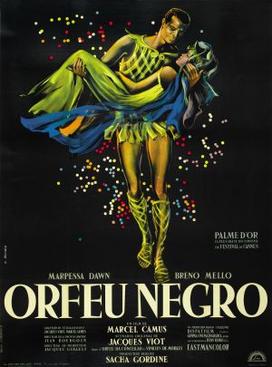
Black Orpheus (Portuguese: Orfeu Negro) is a 1959 film made in Brazil by French director Marcel Camus. It is based on the play Orfeu da Conceição by Vinicius de Moraes ("The Girl from Ipanema"), which is an adaptation of the Greek legend of Orpheus and Eurydice, setting it in the modern context of Rio de Janeiro during the Carnaval. The film was an international co-production between production companies in Brazil, France and Italy.
The film is particularly renowned for its soundtrack by bossa nova legend Antonio Carlos Jobim, featuring songs such as "Manhã de Carnaval" (written by Luiz Bonfá) and "A felicidade" that were to become Bossa nova classics.
Black Orpheus won the Palme d'Or at the 1959 Cannes Film Festival as well as the 1960 Academy Award for Best Foreign Language Film and the 1960 Golden Globe for Best Foreign Film (in those awards the film was credited as a French production; only in the 1961 BAFTA Award for Best Foreign Language Film was Brazil credited together with France and Italy).

"Manhã de Carnaval" is the most popular name of the song by Luiz Antonio Maria Bonfá and recorded the soundtrack of the movie "Black Orpheus," in 1959. This song became the means of traditional american Jazz and is also played regularly for many international artists. The song is considered one of the most important songs in Jazz Brazilian market in the U.S. who helped establish the Bossa Nova movement of the end of the decade of the 50th There are also other versions of the song with lyrics adapted to the English, but the most popular, even abroad, is still the name and the letter in Portuguese. Several big names in music have interpreted this song, with instrumental versions or the original version with vocals, names such as Chet Atkins, John McLaughlin, George Benson, Placido Domingo, Stan Getz, etc..
"Manhã de Carnaval" introduced Luiz Bonfá to fame with international recognition in 1959: Bossa Nova to presenting the world with its vast production sound on discs of various artists, with the international launch of the film Black Orpheus, and with the presentation of several shows of Luiz Bonfá Abroad and other popular names of international music market of interpreting the song in live audiences in other countries.


1 comment:
the global influence of Brazillian music is incredible, not only for the great musicians who have brought your music out to the world, but also those outside like Stan Getz and Les Baxter and others who have fallen in love with your styles and struggled to emulate them. In that second group, an album that has long been a favourite of mine is the Dave Pike Set's "Salamao" where he partners with a group who call their musical style "Baião". So nice ...
Can you recommend any other examples of traditional or modern/jazz Baião music?
Post a Comment