Showing posts sorted by relevance for query christmas. Sort by date Show all posts

Saturday, December 27, 2008

A Christmas dinner of Mrs Emengarda


My dear mother, Mrs Emengarda Floss, is seen in this photo preparing delicacies for the Christmas Eve. "Put it this drip more caipirinhas, which this evening will be very hot," she said to me, Edmundo, her beloved son. My mother danced all night with my father before the Christmas tree next to my guests. The meal of turkey this year was exchanged for eggs fried chicken. All this because of the global crisis. That in 2009, the turkey back to our supper. (Translated : Google Tradutor)

Saturday, February 21, 2009

The great Vince Guaraldi


Vincent Anthony "Vince" Guaraldi (July 17, 1928 – February 6, 1976) was an American jazz musician and pianist best known for composing music for animated adaptations of the Peanuts comic strip.

His first recording was made in November 1951 and came out early in 1953. The early 10 inch LP was called The Cal Tjader Trio, which included the tunes "Chopsticks Mambo," "Vibra-Tharpe," and "Lullaby of the Leaves." By 1955, Guaraldi had put together his own trio with Eddie Duran and Dean Reilly. He then reunited with Cal Tjader in June, 1956 and was an integral part of two great bands that the vibraphonist assembled. The first band played mainly straight jazz and included Al Torre on drums, Eugene Wright on bass and Luis Kant on congas and bongos. The second band was formed in the spring of 1958 and included Al Mckibbon on bass, Mongo Santamaria on congas and bongos and Willie Bobo on drums and timbales. Reed men Paul Horn and Jose ‘Chombo’ Silva were also added to the group for certain live performances and recordings. He made a big splash with his performance with Tjader at the 1958 Monterey Jazz Festival.

Guaraldi left the group early in 1959 to pursue his own projects full time. He probably would have remained a well-respected, but minor jazz figure had he not written an original number to fill out his covers of Antonio Carlo Jobim/Luis Bonfa tunes on his 1962 album, Jazz Impressions of "Black Orpheus, inspired by the French/Brazilian film Black Orpheus, which won an Academy Award for Best Foreign Language Film. Fantasy released "Samba de Orpheus" as a single, trying to catch the building bossa nova wave, but it was destined to sink without a trace when radio DJs began flipping it over and playing the B-side, Guaraldi's "Cast Your Fate to the Wind." A gentle, likeable tune, it stood out from everything else on the airwaves, and became a grass-roots hit. It also won the Best Original Jazz Composition. While "Cast Your Fate To The Wind" by Guaraldi achieved modest chart success as a single in 1963, a cover version two years later by British group Sounds Orchestral cracked the Billboard top 10 (in the spring of 1965). Unlike many songwriters who grow weary of their biggest hits, Guaraldi never minded taking requests to play it when he appeared live. "It's like signing the back of a check," he once remarked.

Nevertheless, his most recognized tune is "Linus and Lucy" from A Charlie Brown Christmas, a song which is known by fans worldwide as the musical signature of the Peanuts franchise.


The LP with the brazilian music BOLA SETE


Compositions for Charles Schulz's Peanuts

While searching for just the right music to accompany a planned Peanuts television documentary, Lee Mendelson (the producer of the special) heard a single version of "Cast Your Fate to the Wind" by Vince Guaraldi's trio on the radio while traveling in a taxicab on the Golden Gate Bridge in San Francisco, California. Mendelson contacted Ralph J. Gleason, jazz columnist for the San Francisco Chronicle and was put in touch with Guaraldi. He proposed that Guaraldi score the upcoming Peanuts Christmas special and Guaraldi enthusiastically took the job, performing a version of what became "Linus and Lucy" over the phone two weeks later. The soundtrack was recorded by the Vince Guaraldi Trio, whose other members were bassist Fred Marshall and drummer Jerry Granelli. Guaraldi went on to compose scores for sixteen Peanuts television specials, plus the feature film A Boy Named Charlie Brown as well as the unaired television program of the same name.

Vince for Edmundo choice's !!!
Blue Charlie Brown / Brasilia / Christmas Time Is Here (vocal and remixed) / Corcovado / Dor que faz Doer (Brazilian Jazz - Bossa Nova) / Fascinating Rhythm / It's de-lovely / L'Amore / Manhã de Carnaval (Brazilian Jazz - Bossa Nova) / Moon River / Mr. Lucky / O Nosso Amor (Brazilian Jazz - Bossa Nova) / Pebble Beach / Schroder / Since I Feel For You / Tha Lady's In Love With You / Three Coins in the Foutain / Tristeza Não tem Fim (Brazilian Jazz - Bossa Nova) / What Kind of fool Am I / You're In Love Charlie Brown / Zelão (Brazilia Jazz - Bossa Nova / With Bola Sete : Choro, Mambossa, Menino Pequeno da Bateria, Moon Rays, Star Song e The Days Of Wine and Rose

Thursday, June 9, 2011

Meco - Pop Goes The Movies (1982)


Meco (real name Domenico Monardo, born 29 November 1939) is an American record producer and musician, as well as the name of a band or production team based around him. Meco is best known for his 1977 disco (Space Disco) version of the Star Wars theme from his album Star Wars and Other Galactic Funk; both the single and album were certified platinum in the U.S.


Albums Star Wars and Other Galactic Funk (1977)
Encounters Of Every Kind (1977)
Meco Plays The Wizard of Oz (1978)
Superman & Other Galactic Heroes (1978)
Moondancer (1979)
Meco Plays Music from The Empire Strikes Back (10" EP – 1980)
Christmas In The Stars: Star Wars Christmas Album (1980)
Music From Star Trek and Music From The Black Hole (1980)
Across The Galaxy (1980)
The American Werewolf In London (1981)
Pop Goes The Movies (1982)
Swingtime's Greatest Hits (1982)
Ewok Celebration (1983)
Hooked on Instrumentals (1985)
The Best of Meco (1997)
The Complete Star Wars Collection (2000)
Star Wars Party (2005) (This release is only sold on the Internet, a retail release with identical musical content was released as Music Inspired By Star Wars)

Saturday, December 20, 2008


The mother of Edmundo, Emengarda lady is seen in this picture preparing themselves for a Christmas dinner. "Edmundo Ros is my favorite musician, so I put the name of Edmundo Floss in my son," says all proud! She loves to serve sponge cake at Christmas.

Tuesday, December 23, 2008

Helper of Santa Claus


Edmundo - dressed in Santa Claus - is assisted by a friend of his taking office to play piano music in the style of Dick Hyman at the Community Christmas Project. Every year in the days leading up to Christmas, the author of the blog LOUNGE MUSIC, performs actions such joy to people, happy life and commented: "holly holly!

Monday, December 15, 2008

Pics


Above : Edmundo (right) in the dinner with his friends office. Banana, coffee and lounge music to salute the christmas time. Prosit !!!
Below Edmundo's office in Brazil, south america, in december. The hot is very hot. But the ice is very cool.

Wednesday, December 17, 2008

It's Xmas Time !!!


Edmundo's friends in a party of christmas time in Floss Studios, Massinotta, Brazil. In this time, Edmundo use a Noel's fantasy and give gift to your friends sayng "Rou rou holly lounge musica!"...

Monday, December 22, 2008

My sons


Despite all that technology exists today, my children chose to make this Christmas toys like those who made our childhood. In the photo, my precious children awaiting a visit from Santa Claus: the twins Emengarda Silva and Petagarda Silva (both in black), McEdmundo the center, Ermenegildo Bruninovia with the car and Silvia with the car baby. My precious ...

Tuesday, June 24, 2014

Johnny Mann, Leader of Easy-Listening Singers, Dies at 85


Johnny Mann, who won two Grammy Awards as leader of the clean-cut easy-listening vocal group the Johnny Mann Singers, died on Wednesday at his home in Anderson, S.C. He was 85.
The cause was heart failure, his wife, Betty, said.
In the 1960s and ’70s, as rock ’n’ roll exerted itself as the driver of a rebellious youth culture, Mr. Mann represented a stolid old guard, musically speaking.
With their gently driven rhythms and tightly controlled harmonies, Eisenhower-era hairdos and neatly natty attire, the Johnny Mann Singers were well scrubbed and tone perfect, recording more than 30 albums of college songs, Christmas songs, patriotic songs, Beatles songs and familiar tunes spanning several musical eras, from “Ol’ Man River” to “Chattanooga Choo Choo” to “Don’t Think Twice, It’s All Right” and “Mrs. Robinson.”
Along with Lawrence Welk, Mitch Miller, Ray Conniff and other bandleaders who offered popular melodies in palatable choral arrangements, Mr. Mann helped define a musical genre that was potently counter-countercultural.
Their first Grammy Award was for the 1961 album “Great Band With Great Voices,” recorded with the Si Zentner Orchestra. That album included the W. C. Handy classic “St. Louis Blues” and the sweetly hopeful romantic ballad “Baubles, Bangles and Beads,” from “Kismet.”
Their second Grammy, in 1967, was for “Up, Up and Away,” including not just the Jimmy Webb composition that gave the album its title, a hit for the Fifth Dimension, but also the Mamas and the Papas favorite “Monday, Monday” and “Somethin’ Stupid,” which Frank and Nancy Sinatra had turned into a popular duet.
From 1971 to 1974, Mr. Mann was the host of “Stand Up and Cheer,” a syndicated television variety show with a patriotic slant that also featured the Johnny Mann Singers, dressed in color-coordinated outfits, and guests like the Lennon Sisters, Andy Griffith, Trini Lopez and Bobbie Gentry.
From 1967 to 1969 he had been music director for “The Joey Bishop Show,” a late-night talk show on ABC that was meant to compete against “The Tonight Show Starring Johnny Carson.” It featured Regis Philbin as Mr. Bishop’s Ed McMahon-style sidekick.
Before that, Mr. Mann was musical director for “The Alvin Show” (1961), the original animated series about three singing chipmunks (it was created following the success of a 1958 novelty record) who have since been revived in a number of television shows and movies.
John Russell Mann was born in Baltimore on Aug. 30, 1928, where his father, Elsworth, was a building superintendent. His mother, Lillian, his primary musical influence, taught piano and voice. After high school, Mr. Mann served in the Army during the Korean War, playing trombone in the Army Field Band.
After mustering out he moved to Los Angeles, where he worked as an arranger and music director for movie studios. In 1956, he was choral director for a short-lived variety show, “NBC Comedy Hour,” that led to the creation of the Johnny Mann Singers. In the late ’50s and early ’60s, the group recorded with Bobby Vee, Johnny Burnette, Walter Brennan and others. The group also became known for recording theme songs and jingles, especially for radio stations.
Mr. Mann’s first two marriages ended in divorce. In addition to his wife, the former Betty Weinmann, whom he married in 1983, he is survived by two daughters, Lori Susan Mann and Jennifer Lee Mann; a sister, Josephine Steciuk; and a grandson.

Monday, August 29, 2011

The incredible Esquivel

Juan García Esquivel (January 20, 1918 – January 3, 2002) often simply known as Esquivel!, was a Mexican band leader, pianist, and composer for television and films. He is recognized today as one of the foremost exponents of a sophisticated style of largely instrumental music that combines elements of lounge music and jazz with Latin flavors. Esquivel is sometimes called "The King of Space Age Pop" and "The Busby Berkley of Cocktail Music." Esquivel is considered one of the foremost exponents of a style of late 1950s-early 1960s quirky instrumental pop that became known (in retrospect) as "Space Age Bachelor Pad Music".

He was born in Tampico, Tamaulipas, and his family moved to Mexico City in 1928 where he studied at the UNAM.

A very rare compilation with Combustible Edison & Esquivel - Miniskirt, Politecnico Rock & Roll, Aurora (Se você fosse sincera) and Universidad Rock & Roll.

Discography

(12" LP releases, US and Mexico)

Las Tandas de Juan Garcia Esquivel (1957, RCA Victor Mexico)
To Love Again (1957, RCA Victor)
Cabaret Tragico (April 1958, RCA Victor Mexico)
Other Worlds Other Sounds (October 1958, RCA Victor)
Four Corners of the World (December 1958, RCA Victor)
Exploring New Sounds in Hi-Fi/Stereo (May 1959, RCA Victor)
The Ames Brothers: Hello Amigos (1959, RCA Victor)
Strings Aflame (August 1959, RCA Victor)
The Merriest of Christmas Pops (1959, RCA Victor)
Infinity in Sound, Vol. 1 (August 1960, RCA Victor)
Infinity in Sound, Vol. 2 (April 1961, RCA Victor)
Latin-Esque (1962, RCA Victor)
More of Other Worlds Other Sounds (1962, Reprise Records)
The Living Strings: In a Mellow Mood (1962, RCA Camden)
The Genius of Esquivel (1967, RCA Victor)
1968 Esquivel!! (1968, RCA Mexico)
Burbujas (1979)
Odisea Burbujas (1980)
Vamos al Circo (1981)


Monday, January 12, 2009

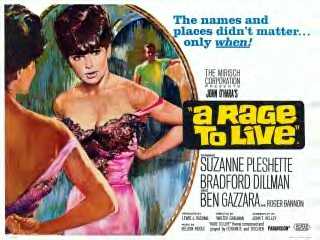
Ferrante e Teicher - A Rage to Live (1965)


A Rage to Live is a 1965 American drama film directed by Walter Grauman. The screenplay by John T. Kelley is based on the 1949 novel of the same name by John O'Hara.
The melodramatic plot centers on newspaper heiress Grace Caldwell, whose nymphomania threatens to destroy the reputation of her staid, wealthy Pennsylvania family. As a precocious teenager, she succumbs to the advances of her older brother Brock's friend Charlie Jay, a decision that apparently ignites her passion for all men.

After a series of meaningless dalliances with strange men in cheap motel rooms, she meets San Francisco real estate broker Sidney Tate at a Christmas party. The two fall in love and he proposes marriage, prompting Grace to confess about her past. Despite being taken aback by her candid revelations, Sidney still wants to marry her, and she commits herself to a monogamous relationship, a pledge she keeps for the first few years of their union, which produces a son and a seemingly idyllic life on a farm.

Problems ensue when lusty contractor Roger Bannon, the son of one of her mother's former servants, arrives to repair their barn and seduces Grace. When she eventually tries to end the affair, he becomes enraged, gets drunk, and accidentally crashes his truck, killing himself. Reports of his death include details about his tryst with Grace, prompting her husband to wonder if she also is involved with newspaper editor Jack Hollister, a suspicion shared by Jack's wife Amy. Brandishing a gun, she publicly confronts Grace at a charity event and attempts suicide but is rescued by Sidney who, realizing she never will change, decides the time has come to begin a new life with his son and leaves his wife.


A Rage to live played by Ferrante & Teicher
Main title / Roger Bannon / Table Talk / Amy / I'd Never Leave You / Why Don't You Tell Her / Kiss me Pumpkin / A Rage to Live / I've got a Husband / Mrs. Bannon / A Two Hour Drive / End Title

Sunday, December 21, 2008

The postman always ring twice


Even though Sunday, Edmundo called and received the postman in his office to send off to your friends the presents of Christmas. In the photo, one of the packages: a bag full of cigars, rum, cashew nut, coffee and many Brazilian products. The destination: the friends who visit your blog posts and leave LOUNGE MUSIC commenting on the music available. If, in 2008, you said any post, no doubt receive a visit from Noel this year!

Saturday, December 27, 2008

A letter to Santa Claus


On the night leading up to Christmas, my son, MacEdmundo was seen in his room in front of his desk, writing a letter to Santa Claus good. As all its simplicity, he sought peace to the world and, of course, an iPod Nano, a new digital camera and a very dollars in any one bank in Switzerland. (Translation: Google translator)